Faith That Never Left the Mountain
 vrtour-16-06-18-03.jpg)
There are places where faith is no longer regularly celebrated, yet has not disappeared.
It is not expressed through ritual, not heard in spoken prayer, not sustained by a visible community. And yet, it remains—quietly, enduringly, as a dimension inseparable from the space itself.
Bokor Church carries such a presence.
During the years when the building no longer served its original function, the absence of liturgical life was evident. There were no Masses, no gathered community, none of the familiar signs of religious practice.
But this does not mean that the place became empty.
There is a difference between the absence of activity and the absence of meaning.
At Bokor Church, that meaning has remained—not through form, but through the very existence of the structure within its unique setting.
A church built on a mountaintop is not merely a choice of location.
It is a symbolic act.
From early in the Christian tradition, mountains have been associated with moments of encounter: places where humanity meets God, where transformation occurs, where the call becomes clearer in silence. The mountain is not a place of noise, but of separation—where one can listen.
Bokor Church stands within this very context.
Amid forest, mist, and wind, the structure does not impose its presence, but exists as part of the landscape. It is this humility that gives the place a particular quality: a space open to contemplation, even in the absence of any formal religious activity.
Faith here is not sustained through regular rhythm. It is held in a latent form.
Present in the way the structure continues to stand through time.
Present in the experience of those who come, even without ritual.
Present in the silence itself—a silence that is not empty, but full.
%20vrtour.jpg)
This offers a different perspective on restoration.
To restore Bokor Church is not only to recover a space for liturgical celebration, but also to recognize and preserve the spiritual dimension that has remained here, even through periods that seemed marked by interruption.
Not all spiritual value needs to be made explicit.
Some values endure precisely because they remain quiet.
Bokor Church, therefore, is not a place where faith “once existed.”
It is a place where faith has never left.
And within this understanding, restoration becomes more than bringing people back to a space. It becomes an invitation to recognize that this place has always been waiting— in silence, yet never in absence.
Bài viết khác
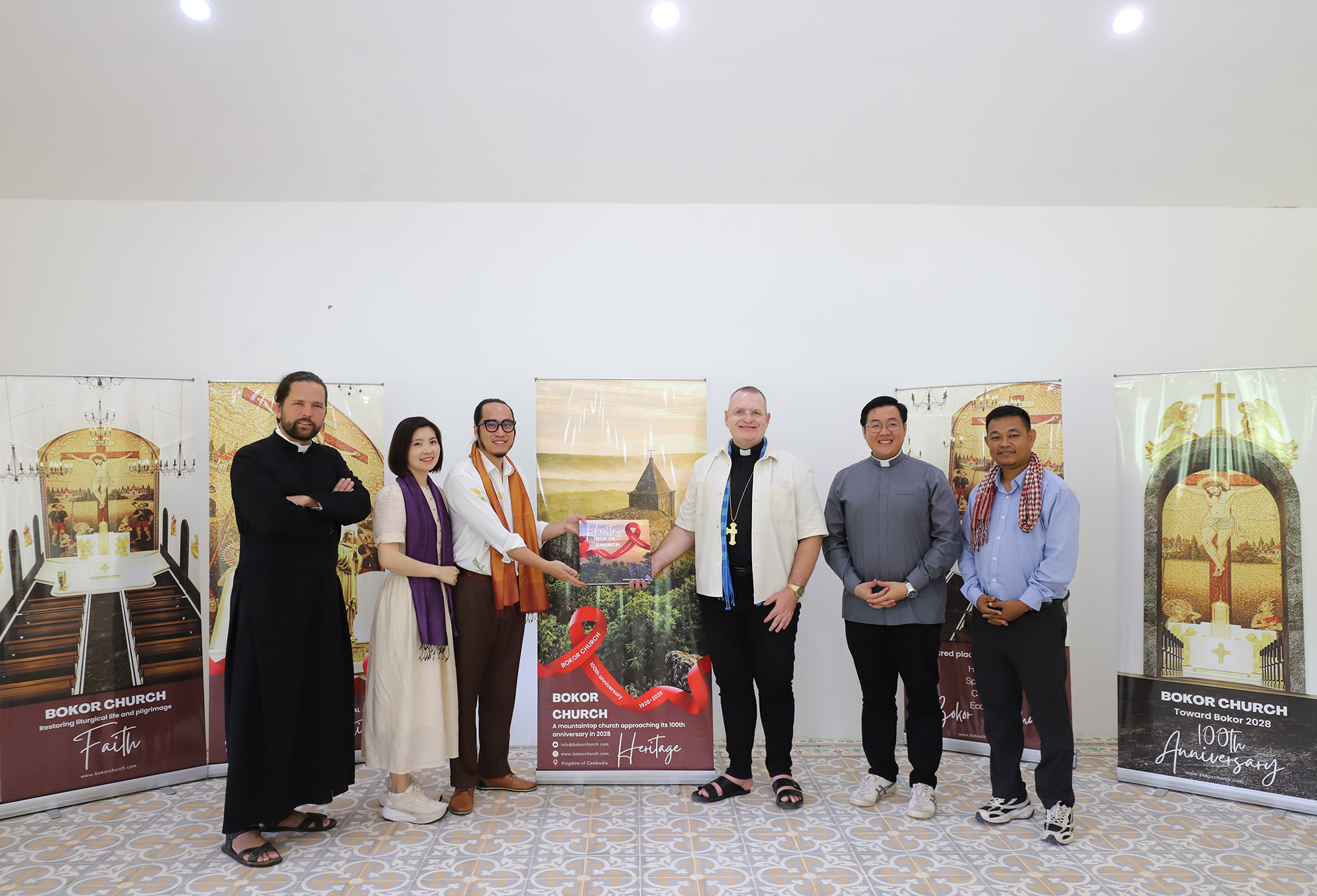
The Second Reunion of the Bokor Steering Committee
On Thursday, June 11, 2026, the Bokor Steering Committee convened its second reunion at the peaceful Eden Voar resort in Kep Province
-21-37-30-03.jpg)
PALM SUNDAY AT BOKOR CHURCH
On the morning of March 29, atop Bokor Mountain bathed in sunlight and wind, the Palm Sunday Mass
-15-59-24-03.jpg)
The Liturgical Future of Bokor
A religious building is only truly complete when it is used according to its original purpose.