Preparing the Path to 2028
 vrtour-16-12-18-03.png)
Every restoration project requires a point of arrival.
Not as an end, but as a direction—so that each step, however small, belongs to a meaningful structure.
For Bokor Church, the year 2028 is not merely a point in time. It marks the centenary of the church’s construction—a moment of particular significance, when the building may be received once again into the life of faith and community.
Yet the journey toward that milestone cannot be understood as a simple linear process.
It demands preparation on multiple levels.
First is the technical level.
The phases of survey, research, stabilization, and restoration must follow a clearly defined sequence, in which each step depends on the outcome of the previous one. There is no place for accelerating progress by bypassing intermediate stages.
Next is the organizational level.
The restoration of Bokor Church is not the work of a single group of specialists, but a coordinated effort among multiple stakeholders: the Church, public authorities, conservation experts, and partners both local and international. Establishing an effective, transparent, and enduring framework of collaboration is essential to ensure the continuity of the project.
Another crucial factor is resources.
Heritage restoration—especially within the geographical and climatic conditions of Bokor—requires not only financial means, but also human capacity and professional expertise. Fundraising, building partnerships, and cultivating community support are integral parts of the process.
Equally decisive is the environmental dimension.
Bokor Church lies within a sensitive ecosystem, where every intervention must be carefully controlled. This requires the project to constantly balance the need for restoration with the responsibility of protecting the natural landscape—a balance that is not easily achieved, yet must be maintained.
These elements do not exist in isolation.
They are interconnected, forming an integrated structure in which each decision influences multiple aspects of the project.
In this context, “preparation” is not merely a preliminary stage before construction.
It is an ongoing process—of adjustment, verification, and adaptation—ensuring that the project remains aligned with reality and faithful to its guiding principles.
The year 2028, therefore, is not a pressure.
It is a point of convergence—a moment toward which all efforts, from research and organization to implementation, are directed, with a shared purpose: to bring Bokor Church back as a place that can be used, experienced, and preserved in a sustainable state.
The path toward that point is neither short nor simple.
Yet through the careful preparation of each step, the journey gradually becomes clearer—not because everything is predetermined, but because each step is grounded on a solid foundation.
Bài viết khác
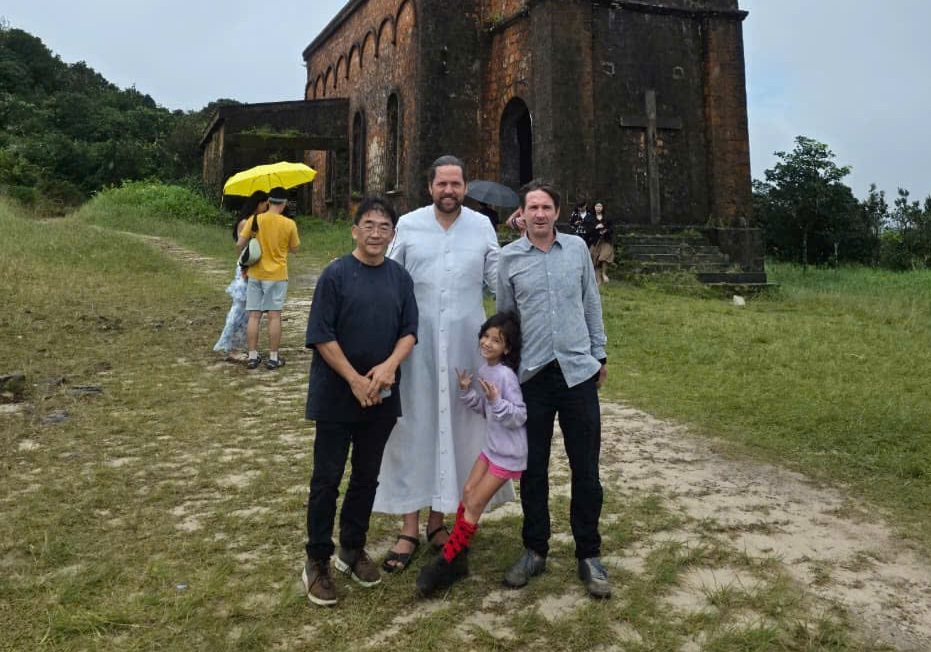
Professor Yoshiyuki Yamana Visits Bokor Church: Valuable Academic Support for Heritage Conservation
On Sunday, 18 October 2026, Professor Yoshiyuki Yamana of the Department of Architecture, Faculty of Science and Technology at Tokyo University of Science, visited the hi
The Second Reunion of the Bokor Steering Committee
On Thursday, June 11, 2026, the Bokor Steering Committee convened its second reunion at the peaceful Eden Voar resort in Kep Province
-21-37-30-03.jpg)
PALM SUNDAY AT BOKOR CHURCH
On the morning of March 29, atop Bokor Mountain bathed in sunlight and wind, the Palm Sunday Mass