Standing Before a Century of Memory
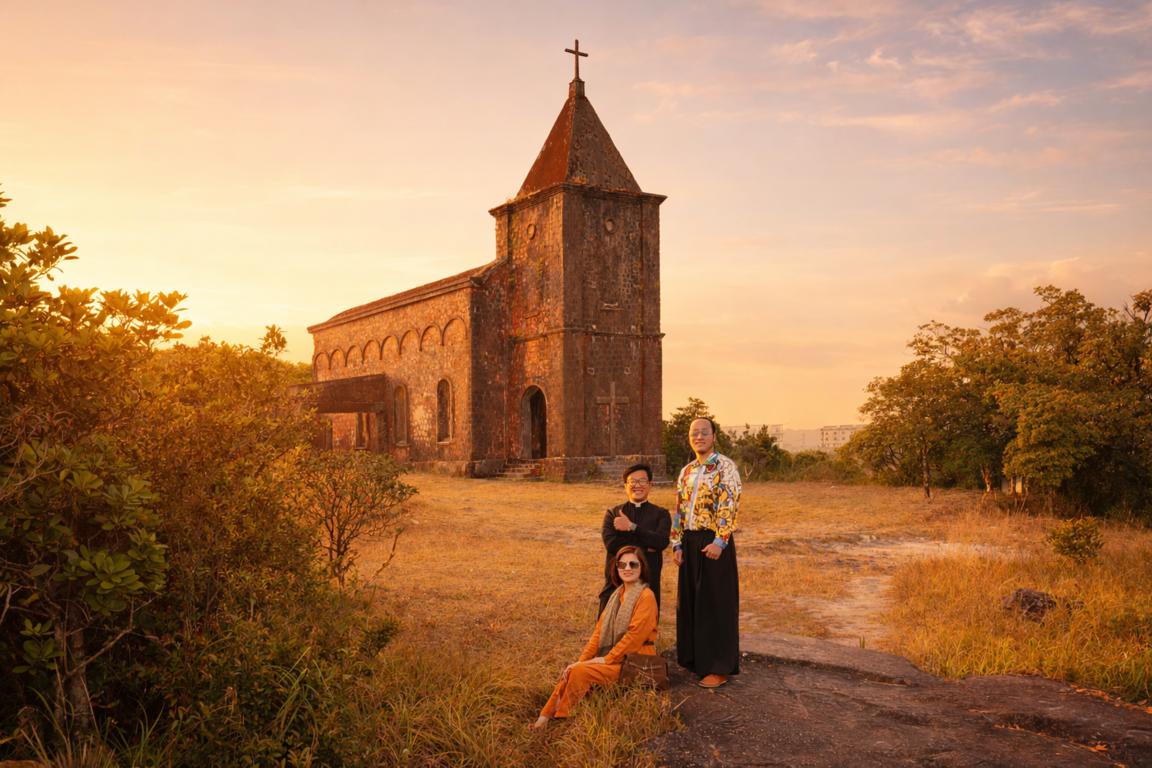
Before a structure that has existed for nearly a century, what is present is not only material.
It is time—a form of presence that cannot be seen directly, yet can be clearly felt in every remaining detail.
Bokor Church does not preserve history in the manner of a document. There are no complete written records, no clearly ordered sequence of events. Instead, history exists as layers—quiet, fragmented, yet enduring.
The stone walls are not merely structural elements. They are surfaces upon which time has left its traces.
There were periods when the building fulfilled its original purpose—when Masses were celebrated, when people came to pray. But there were also entirely different phases, when this space was interrupted, occupied, and placed in conditions that did not belong to its nature.
There is no clear boundary separating these phases. All of them coexist within the present condition of the structure.
This creates an essential characteristic: Bokor Church does not represent a single moment in history, but an accumulation of many. Standing before it, one is not only facing the year 1928—the moment of its construction—but also everything that followed: war, abandonment, and the slow erosion of time.
For this reason, the way we understand the structure cannot be limited to a single layer.
If one attempts to return the church to an “original” state, there is a risk of erasing the layers of memory that came after. Yet without distinction, everything may become blurred and difficult to read.
The challenge lies in this: how to respect the entirety of its historical process, while still preserving the clarity of its different layers of value.
Standing before Bokor Church, the sense of time does not arise from a single detail, but from the totality of the space. Everything bears the mark of having endured—quietly, without urgency, yet undeniably.
Nothing here is “new,” and nothing has completely disappeared.
It is this coexistence that gives the structure its unique character as a form of memory—one that is not closed, but still present.
In such a context, restoration cannot be reduced to a technical act of recovering form. It requires a deeper approach—one that recognizes that every intervention will shape how history continues to be told.
What to retain, what to clarify, and what to allow to continue—these are all decisions of consequence.
Thus, standing before Bokor Church is not simply standing before an old structure.
It is standing before a historical process that has not yet ended.
And within that awareness, the responsibility of restoration becomes clearer: not to change the past, but to ensure that the past can still be rightly understood in the future.
Bài viết khác
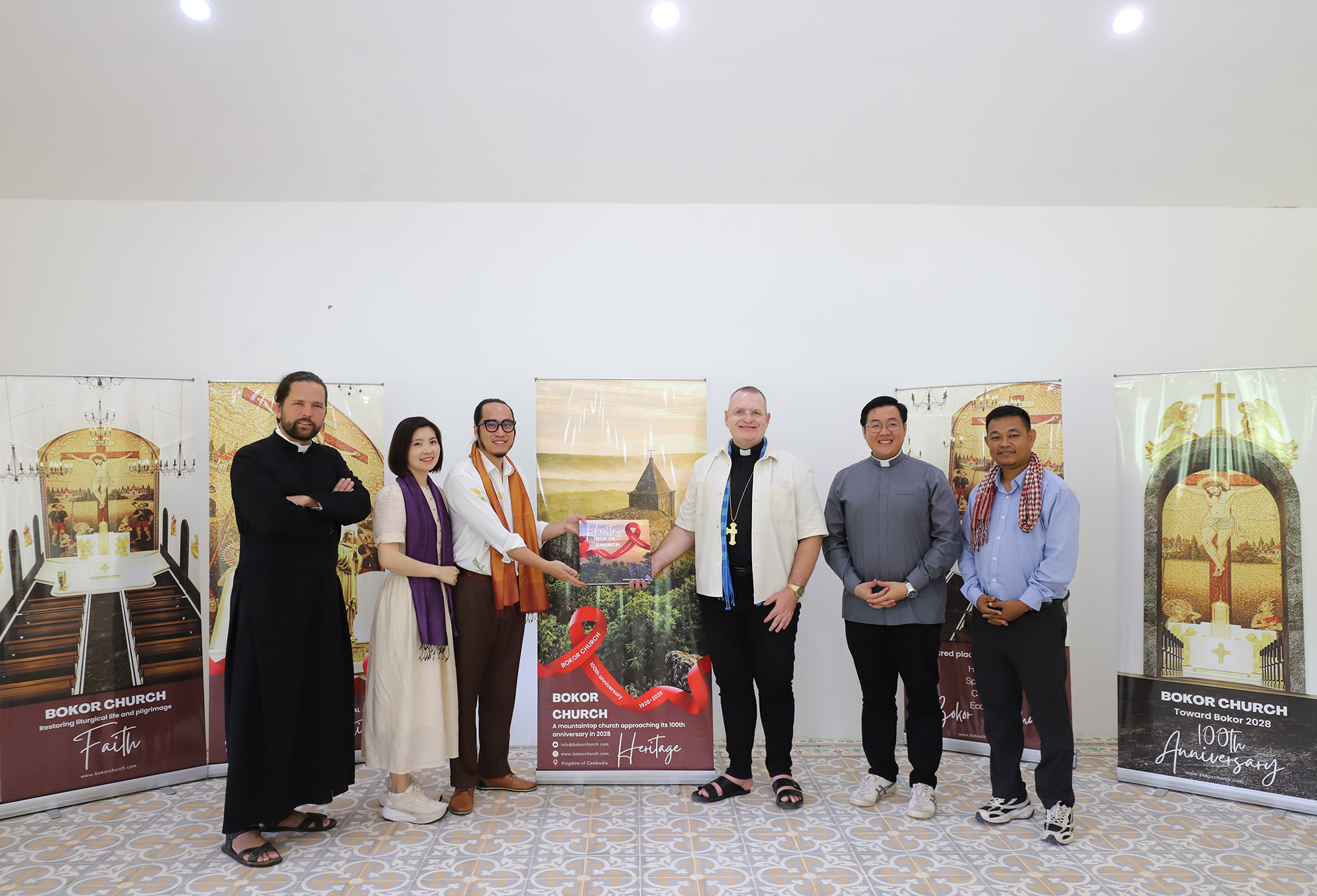
The Second Reunion of the Bokor Steering Committee
On Thursday, June 11, 2026, the Bokor Steering Committee convened its second reunion at the peaceful Eden Voar resort in Kep Province
-21-37-30-03.jpg)
PALM SUNDAY AT BOKOR CHURCH
On the morning of March 29, atop Bokor Mountain bathed in sunlight and wind, the Palm Sunday Mass
-15-59-24-03.jpg)
The Liturgical Future of Bokor
A religious building is only truly complete when it is used according to its original purpose.