When Bokor Called
-15-18-24-03.png)
Not every call resounds with sound. Some calls come quietly, almost imperceptibly, yet carry a depth that cannot be ignored.
Bokor Church revealed itself in this journey in such a way.
At first, it was not a clearly defined plan or a fully formed project. It was only a vague intuition—an image of an old church on a mountaintop, a place that had endured war, abandonment, and time. Yet that very ambiguity carried a particular weight, like an invitation that needed to be heard.
As the first fragments of information about Bokor Church began to emerge, what struck most was not its scale or architectural form, but the story it held. A church built in 1928, once alive with liturgy, later abandoned, occupied during times of war, and existing for decades as a ruin amid the mist of the plateau.
There, architecture was no longer merely a simple form.It had become a testimony.
A testimony of history.
A testimony of faith.
And also a testimony of wounds that have never been fully told.
From that realization, the journey began to take shape—not as a simple task, but as a response. A response to a call coming from a specific place, yet also from memory, from history, and from a responsibility that could not easily be refused.
The deeper the inquiry, the clearer it became that Bokor Church is not only a structure in need of restoration. It is a heritage that must be rightly understood. And to understand, one must first learn to pause—not to rush toward solutions, not to impose the will of the present upon the past, but to listen to what the monument itself carries within.
The call of Bokor Church does not lie in any urgency on the surface, but in the depth of its meaning. It does not demand, yet it persists. It is not loud, yet it is unmistakably clear.
And when one becomes still enough to recognize it, turning away is no longer possible.
Thus began the journey of the Bokor Church restoration project—not from a drawing, but from a call.
A call that invites us not only to rebuild walls, but to confront memory, to rediscover faith, and to reflect on how we choose to preserve the past for the future.
Bài viết khác
The Second Reunion of the Bokor Steering Committee
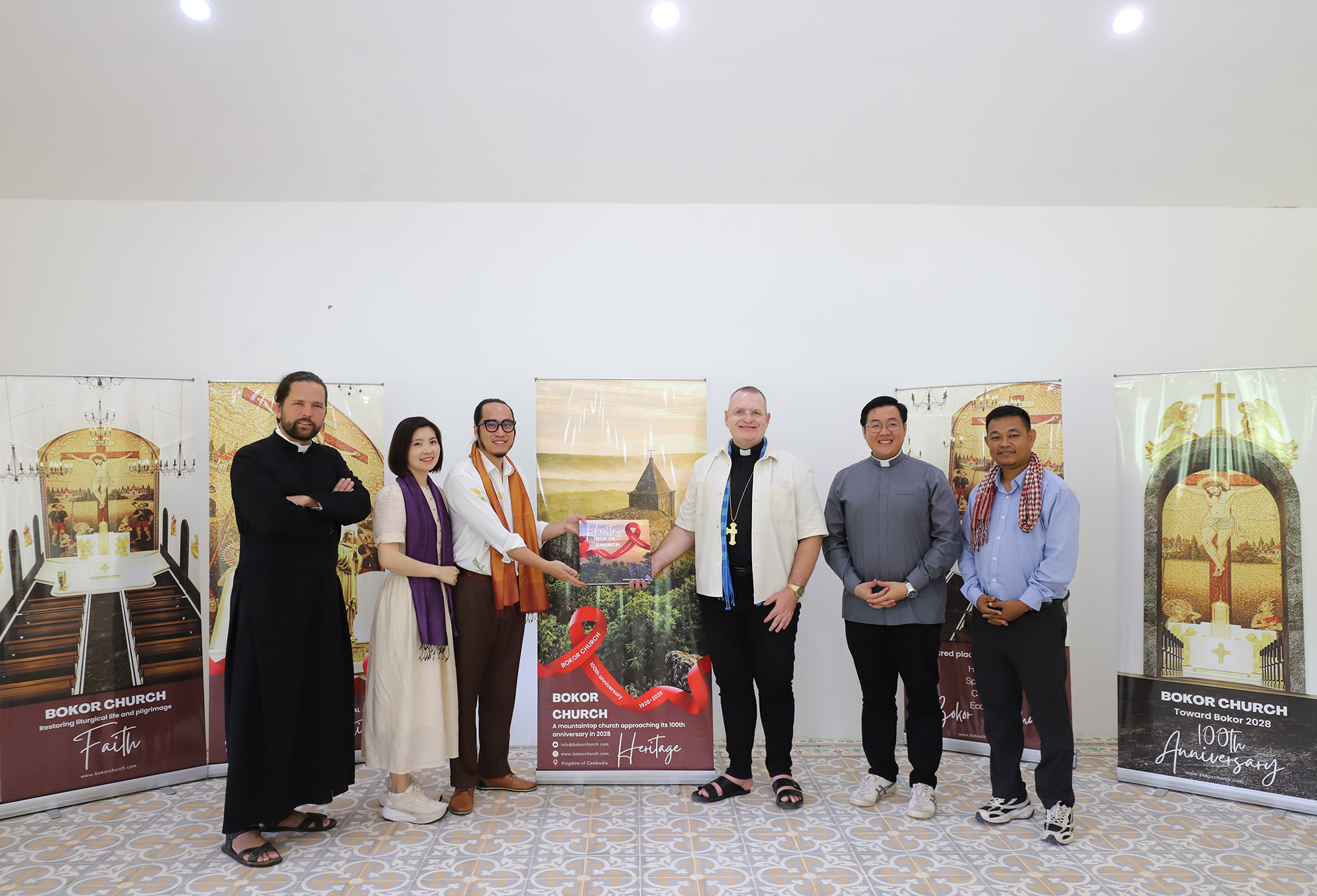
On Thursday, June 11, 2026, the Bokor Steering Committee convened its second reunion at the peaceful Eden Voar resort in Kep Province
-21-37-30-03.jpg)
PALM SUNDAY AT BOKOR CHURCH
On the morning of March 29, atop Bokor Mountain bathed in sunlight and wind, the Palm Sunday Mass
-15-59-24-03.jpg)
The Liturgical Future of Bokor
A religious building is only truly complete when it is used according to its original purpose.